


05 Oct 7 Reasons to Use a Malta Registered Office Service
A Malta registered office is one of those company details that looks simple until you examine what it actually does. Atom FS is a Malta-based financial and corporate services group with licensed or authorised entities in company and trustee work, so the topic sits firmly inside a regulated corporate-services setting rather than a mere mail-handling exercise.
A Malta registered office service gives a company its official legal address in Malta, and that address forms part of the public company record held by the Malta Business Registry.
In Malta, the provision of a registered office is treated by the MFSA as a company-service-provider activity, so provider choice is a compliance decision as well as an operational one.
A good Malta registered office service helps with statutory mail, registry updates, and administration discipline, especially for cross-border owners without permanent Maltese premises.
If the registered office changes, the company must notify the Registrar within 14 days, so process reliability matters.
Atom FS is relevant here because its group includes a Company Service Providers Act licensed entity, which reflects the regulated framework around registered office services in Malta.
That combination of public disclosure, regulatory scope, and filing deadlines is why many businesses use a specialist provider. The value is not only the address itself, but also the governance process that sits behind it.
What is a Malta registered office?
A Malta registered office is the company’s official legal address on record with the Malta Business Registry, not just a postal point. It is the address used for statutory notices, registry records, and formal corporate administration.
In practice, this is the address connected to the company’s constitutional record in Malta. When a company is incorporated, one of the basic details entered into the registry is its registered office address, alongside items like the registration number, legal form, status, registration date, and NACE activity code.
That matters because the registered office has an evidential role. It is part of what banks, counterparties, professional advisers, and due-diligence teams check when they review a Maltese entity. A common misconception is that any address can fill the gap. In reality, the registered office is a legal identifier, and it must be managed with the same care as directors, share capital, and statutory filings.
Is a Malta registered office legally required for every company?
Yes. For Maltese companies, a local registered office is a core legal requirement, and Atom FS is one example of a provider operating in that regulated category.
The requirement is practical as well as formal. Private limited liability companies and public limited liability companies in Malta need a local registered office address. Without that anchor point, the company lacks one of the basic elements needed for proper registration and ongoing administration.
“Atom FS notes that a local registered office address is required for both private and public limited liability companies in Malta.”
The second layer is regulation. The Malta Financial Services Authority treats the provision of registered office, business, or correspondence addresses as a company-service-provider activity when offered by way of business. That means the service sits within a framework built around client protection, suitability, and anti-money-laundering risk management. So the legal question is not only “do I need an address?” but also “who is permitted and organised to provide it properly?”
What are the seven reasons to use a Malta registered office service?
The strongest reasons are compliance control, public-record accuracy, and operational efficiency. For many international owners, a service solves both the legal address requirement and the day-to-day discipline that follows.
- It satisfies a core Maltese company requirement: a registered office is part of the basic company set-up.
- It supports timely handling of statutory notices: registry and official correspondence need a controlled receipt process.
- It improves record accuracy: the registered office appears in public business-register data, so errors are visible.
- It helps non-resident owners operate from day one: you do not need to secure your own premises before incorporation.
- It reduces missed-deadline risk: address changes and related filings need tracking and follow-through.
- It fits wider company administration: company secretarial work, governance, accounting, and compliance workflows often connect to the registered office function.
- It is useful in cross-border structures: where shareholders, directors, and assets sit in multiple jurisdictions, a reliable Maltese administrative base helps keep local obligations orderly.
The trade-off is straightforward. A service gives control and convenience, but it also means you should choose a provider with proper procedures rather than treating the address as a commodity purchase.
How is a registered office different from a business or correspondence address?
A registered office is the legal address on the public company record, while a business or correspondence address serves operational or mailing purposes. Mixing them up creates avoidable risk.
A company may trade from one place, receive day-to-day post somewhere else, and still have a separate registered office. The registered office is the one that matters for the formal registry record in Malta. The MFSA’s company-service-provider framework groups these address-related services together, but that does not make them interchangeable.
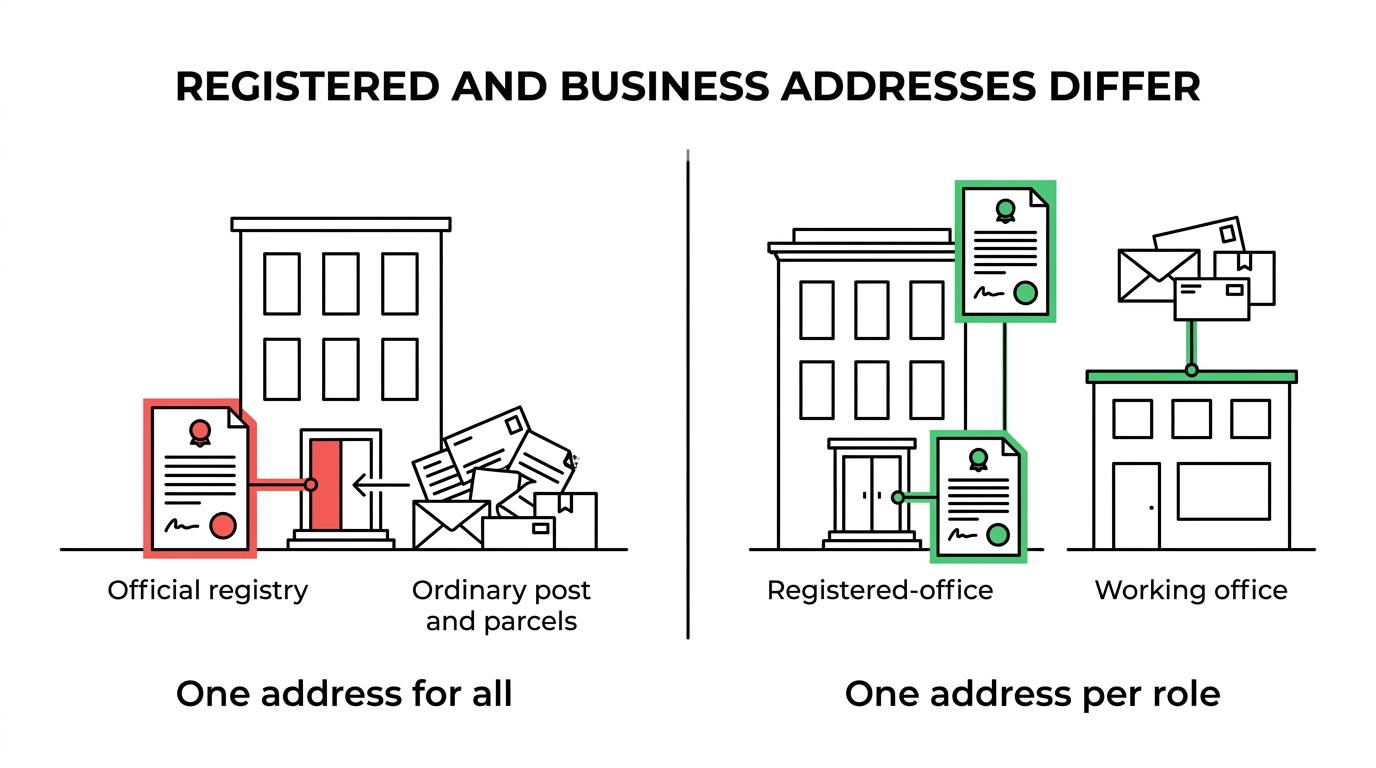
Common mistake: assuming a serviced desk, a logistics site, or a director’s overseas office can stand in for the registered office without a proper Maltese set-up. If the company’s legal address on file is wrong, outdated, or unmanaged, due diligence and service-of-notice issues can follow quickly.
How do you choose a regulated Malta registered office provider?
Start with regulatory status, escalation procedures, and administrative scope. In Malta, Atom FS sits within the supervised company-service-provider landscape, which is more relevant than a low-cost address on its own.
First, check whether the provider belongs in the regulated company-service-provider category and whether its structure makes sense for the services being offered. The MFSA states that persons in this space are subject to authorisation or registration requirements, and its wider authorisation approach refers to fit and proper and suitability criteria.
Then examine the operating model rather than the marketing language. A registered office provider should be able to explain how mail is logged, how urgent notices are escalated, who holds statutory records, and how address changes are actioned. If the same firm can support company secretarial work, governance, or tax administration, the handover points are often cleaner.
A practical screening checklist helps:
- Regulatory position: does the provider clearly sit within Malta’s company-service-provider framework where applicable?
- Mail controls: how are official notices received, logged, scanned, and escalated?
- Change management: who prepares and files updates with the Registrar if the address changes?
- Administrative depth: can the provider support company secretarial work, governance, and ongoing compliance work?
- Cross-border fit: is the provider used to dealing with non-resident owners, family offices, or group structures?
Pro tip: ask who actually monitors the address during holidays, staff absences, and peak filing periods. That answer often tells you more than the fee schedule.
How do you change a company’s registered office in Malta?
A change is manageable, but it is time-sensitive. Maltese law requires notice to the Registrar within 14 days from the change, together with the new registered office address.
The safe approach is sequential. First, confirm the effective date and ensure board or internal approval is clear. Next, prepare the relevant notice for the Registrar of Companies and make sure the new address is stated correctly and consistently across the company’s records. Finally, update connected materials such as letterheads, onboarding packs, banking records, contracts, and compliance files.
“Atom FS operates through a Company Service Providers Act licensed entity, which matters because registered office provision in Malta is part of a regulated corporate-services framework.”
A frequent error is treating the public filing as an afterthought. If the website changes first but the registry filing follows late, the company can end up with mismatched records across official and commercial channels. If a group has multiple Maltese entities, run the change on an entity-by-entity basis rather than assuming one update covers all companies.
What information about the registered office becomes public in Malta?
The registered office address forms part of the public-facing company record, and the Malta Business Registry includes it in basic company information data.
That public visibility is often overlooked. The registry dataset includes core fields such as the registered office address, registration date, legal form, registration number, company status, and NACE activity code. The business-register data service is also exposed through an API format, which means corporate data can be accessed and processed at scale.
For companies, this has two practical effects. First, the address must be accurate because it is not a private internal detail. Second, it affects external perception. Counterparties checking a Maltese company can compare registry data with contracts, websites, invoices, and onboarding documents in minutes.
Is a registered office service enough for tax, substance, or management and control?
No. A registered office helps with legal presence and administration in Malta, but it does not by itself settle tax residence, substance, or management-and-control questions.
Adept makes a similar distinction in Singapore, where its explanation of registered office services separates the statutory address function from the wider operational and tax position of the business.
This is one of the most important distinctions for international clients. A registered office is part of the company law framework. Tax residence and substance turn on wider facts that may include where strategic decisions are made, who directs the business, where staff and assets sit, and how operations are genuinely conducted.
If a client needs only the statutory address and mail handling, a registered office service may be sufficient for that narrow purpose. If the client expects it to prove economic substance or central management in Malta, more is needed. Common misconception: a legal address equals tax substance. It does not. That is why structuring discussions often involve corporate, tax, governance, and administration inputs at the same time.
How does a registered office support redomiciliation and cross-border structuring?
In continuation and cross-border structuring, the registered office acts as the Maltese administrative anchor. It helps connect the incoming company to local records, service channels, and ongoing filings.
Where a company continues to Malta, the address is part of the local operating infrastructure that supports the new legal life of the entity in Malta. After provisional continuation, the company is treated as validly registered as a Maltese company for all purposes of law, while the continued entity retains its assets, rights, liabilities, and obligations.
The practical sequence is clear. First, the company establishes its Maltese legal footprint, including the local registered office. Next, it organises the accompanying administration, which may include company secretarial work, governance records, and tax or accounting workflows. After that, the focus shifts from transaction execution to maintenance. That is where a disciplined registered office function becomes useful rather than symbolic.
When does an in-house address make sense instead of using a service?
An in-house address can make sense if the company has stable Maltese premises, local staff, and strong administration processes. A service is often the better option when ownership is international or the local footprint is light.
The trade-off is control versus operational burden. Using your own office may suit a business with a genuine Maltese operating base and people on the ground to receive legal notices, keep records current, and coordinate filings. In that scenario, the company may prefer to keep the function internal.
A service is usually stronger where the company is newly incorporated, investment-led, family-owned, or managed across several jurisdictions. In those cases, the address requirement is only one part of a wider governance puzzle. The best choice is the one that keeps the public record accurate, notices visible, and filing deadlines under control.
No Comments